



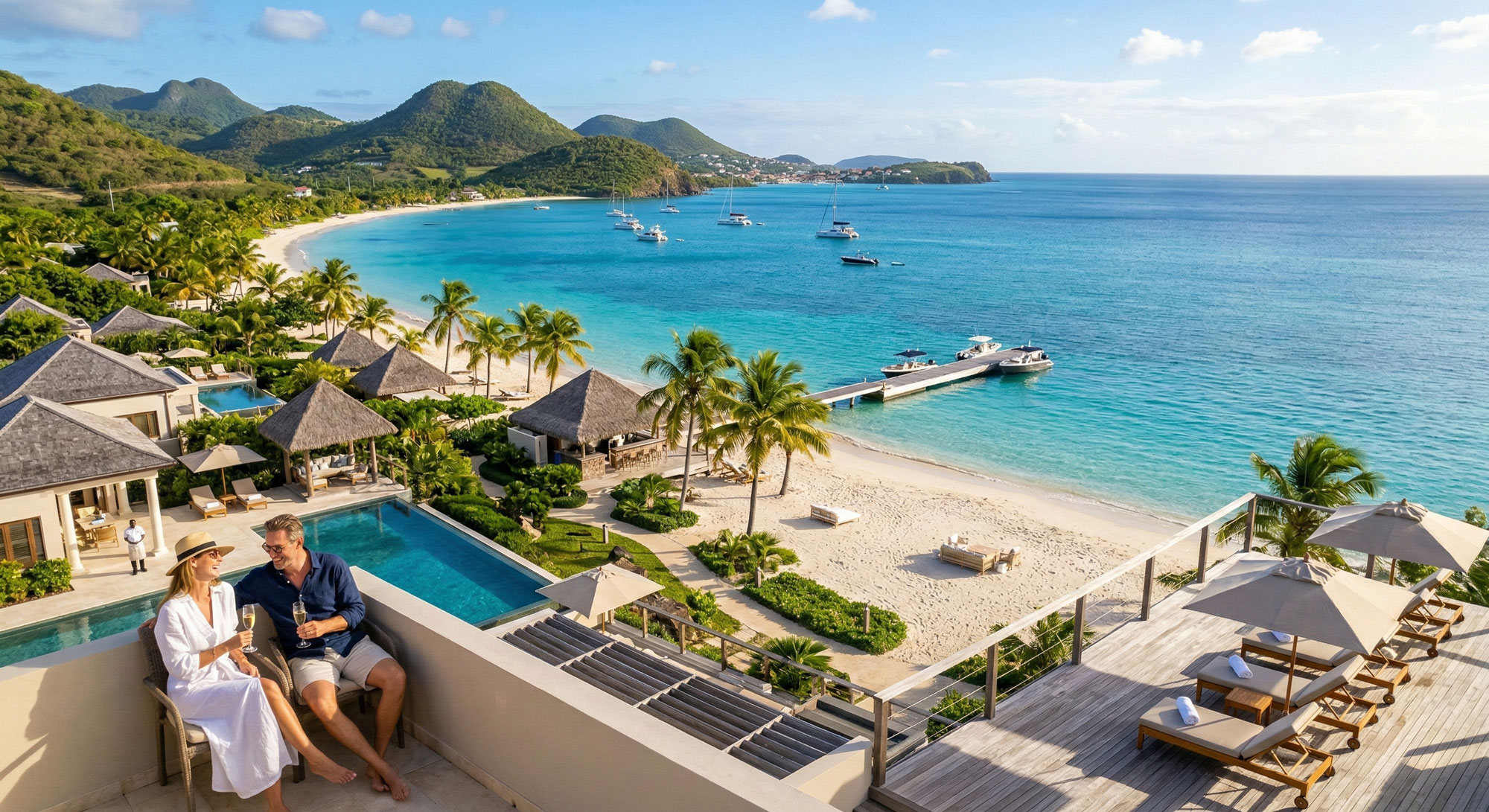
Timing is one of the most important factors when planning a luxury vacation rental in the Caribbean. Choosing the right time of year not only ensures ideal weather but also gives you access to the best villa availability, allows you to negotiate the best rates, and lets you make the most of local life. Every season in the Caribbean has its pros and cons—here’s the complete guide to making the right choice.
The Caribbean climate calendar: what you need to know
The French Caribbean has two main seasons:
Carême: the dry season (December to April)
Carême is the tourist season, and for good reason: it’s the mildest time of year. Nearly constant blue skies, moderate humidity, temperatures between 26 and 30°C, and refreshing trade winds. The sea is calm, and the beaches are at their most beautiful. It’s the peak season for luxury vacation rentals.
Pros: ideal weather, lively local scene, bustling markets and restaurants, clear waters for diving and snorkeling.
Cons: The most sought-after villas are often fully booked, rates are at their highest, and tourist traffic is heavier at popular sites.
IBAÏA Tip: Book 6 to 12 months in advance for the high season. The best villas are snapped up as soon as the calendar opens.
The Rainy Season: the wet season (July to November)
The rainy season is the hurricane season. While hurricanes rarely make direct landfall on the islands (and even less so on the French Antilles, which are less exposed), the period from July to October can see episodes of heavy rain, overcast skies, and rough seas. September and October are statistically the riskiest months.
Advantages: very attractive rates (30 to 50% cheaper than in high season), few tourists, absolutely lush vegetation, spectacular tropical light, a more relaxed local atmosphere.
Disadvantages: unpredictable weather, risk of tropical storms, some service providers scale back their operations, and a few villas close in August and September.
IBAÏA Tip: If you choose to visit during the rainy season, opt for June, November, or early December. Avoid September–October for a luxury stay.
Month-by-month calendar: our recommendation
| Month | Season | Weather | Rates | Our opinion |
|---|---|---|---|---|
| January | Lent | ⭐⭐⭐⭐⭐ | $$$$$ | Excellent, book early |
| February | Lent | ⭐⭐⭐⭐⭐ | $$$$$ | The best month |
| March | Lent | ⭐⭐⭐⭐⭐ | $$$$ | Perfect, still available |
| April | End of Lent | ⭐⭐⭐⭐ | $$$$ | Very good, cheaper |
| May | Transition | ⭐⭐⭐⭐ | $$$ | Excellent value for money |
| June | Start of the rainy season | ⭐⭐⭐ | $$$ | Fair, a few showers |
| July | Rainy season | ⭐⭐⭐ | $$ | Good plan if flexible |
| August | Rainy season | ⭐⭐ | $$ | Increasing hurricane risk |
| September | Hurricane season peak | ⭐ | $ | Not recommended |
| October | Rainy season | ⭐⭐ | $ | Still risky |
| November | End of the dry season | ⭐⭐⭐ | $$$ | Good option, splendid vegetation |
| December | Start of Lent | ⭐⭐⭐⭐⭐ | $$$$$ | Christmas = peak season |
Must-see events by season
Certain dates set the tone not only for the weather but also for the islands’ cultural and festive calendar:
December–January: Creole Christmas and New Year’s
The end-of-year celebrations in the Caribbean are an experience all their own. Christmas markets, gwoka concerts in Guadeloupe, live nativity scenes in Martinican villages, fireworks over the sea: a unique atmosphere. Luxury villas command premium prices during these weeks—but the experience is worth every penny.
February – March: Carnival
Martinique’s Carnival is one of the largest and most authentic in the Caribbean. Four days of parades, music, and extravagant costumes—a total immersion in Creole culture. In Guadeloupe, the Pointe-à-Pitre Carnival is just as festive. Ideal for travelers curious about culture.
July: The Rum Festival in Martinique
Tastings, distillery tours, and exclusive events centered around Martinique’s AOC agricultural rum. A perfect time for lovers of fine dining and the Creole art of living.
August: The Cooks’ Festival in Guadeloupe
In Pointe-à-Pitre, the Fête des Cuisinières is a unique event: the island’s women parade in traditional attire with their home-cooked dishes, have their kitchen utensils blessed at church, and then host a grand public Creole banquet. A glimpse into authentic local life.
How long should you stay in a luxury villa in the Caribbean?
1 week: the minimum for a luxury villa. Enough for one island, not enough to explore several. Ideal for couples on a romantic getaway in Martinique or Guadeloupe.
2 weeks: the ideal length of stay. It allows you to explore one island in depth AND take a catamaran trip to a neighboring island, or combine two destinations (e.g., Martinique + Guadeloupe).
3 weeks or more: for travelers who really want to immerse themselves. It’s possible to cover 3 or 4 islands with inter-island transfers organized by IBAÏA.
Our practical tips before you go
-
Documents: A French ID card or EU passport is sufficient (French Overseas Departments). A passport is required for Saint Barth (collectivity) and Saint Martin.
-
Health: No mandatory vaccinations. Bring mosquito repellent (risk of dengue fever during the rainy season). Tap water is safe to drink in Martinique and Guadeloupe.
-
Money: Euros accepted throughout the French West Indies. No currency exchange necessary.
-
Time difference: UTC-4 year-round. 5 hours behind Paris in summer, 6 hours behind in winter. Minimal time difference, ideal for business trips.
-
Driving: French driver’s license valid. Drive on the right. Roads are sometimes narrow in rural areas—a 4×4 may be useful.
-
Phone: European plans work in the French West Indies (DOM). Standard roaming rates apply.
FAQ — When is the best time to visit the French West Indies?
Can you visit the French West Indies with young children?
Absolutely. Avoid the rainy season (mosquitoes, humid heat, unpredictable weather). The dry season, from January to April, is ideal with children: calm seas, constant sunshine, no risk of hurricanes.
Do Martinique and Guadeloupe have the same climate patterns?
Generally yes, with slight variations. Guadeloupe, further north, is sometimes slightly cooler in winter. Basse-Terre (Guadeloupe) receives more rain than Grande-Terre year-round due to its volcanic terrain.
Should you purchase trip cancellation insurance for a luxury villa rental in the Caribbean?
We strongly recommend it, especially for winter stays or holiday weeks with high rates. Our team can refer you to specialized travel insurance providers.
🔗 See also: Luxury vacation rentals in the Caribbean | Luxury villas in Saint Barth and Saint Martin | Luxury activities in the Caribbean